Tuesday, December 30, 2008

Demonstrations worldwide, against Israeli bombing of Gaza


"Renewed protests at Israeli raids"

Video: Rallies in Indonesia, Iraq, Venezuela, Lebanon and Jordan.


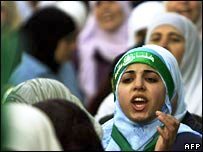
Protests against the Israeli military action in the Gaza Strip have again been taking place, with rallies in several cities across the region.


For a second day in Jordan, several thousand protesters gathered in Amman and burned Israeli and American flags.


There were similar rallies in Egypt, Syria, Libya and Iraq with many calling for a firm response from their leaders.


One of the largest gatherings was in the Lebanese capital, Beirut, organised by the Hezbollah movement.


Tens of thousands of people poured on to the streets of southern Beirut, many carrying Palestinian, Lebanese and Hezbollah flags and banners supporting the Palestinian people, the Associated Press news agency reported.


The rally was called for by Hezbollah leader Hassan Nasrallah, who in a speech on Sunday urged crowds in the Arab and Islamic world to rise up in support of Gaza.


He also urged his fighters in southern Lebanon, who fought a brief war with Israel in 2006, to be on alert in case of Israeli attacks.


In Amman demonstrators, responding to a call by Islamist-led trades unionists, marched to the office of Prime Minister Nader Dahabi and delivered a letter demanding Jordan scrap its 1994 peace treaty with Israel and close its embassy, the AFP news agency reported.


Egyptians staged their largest yet demonstration against Israel's offensive against the Hamas-controlled Gaza Strip, with thousands taking to the streets of central Cairo.


The rally was once again organised by the Islamist opposition in Egypt, the Muslim Brotherhood, the group from which Hamas first emerged.


Elsewhere in the Islamic world, there were anti-Israeli protests in Bangladesh and Pakistan.


____________________________________________________________


Montreal, Canada: Demonstration for the Gaza Strip, for boycott against Israel:


Photos: Montreal stands with Gaza


30 December 2008
| Posted in Boycott, Palestine, Quebec

On the Web at:

http://www.tadamon.ca/post/2277

Photo essay by Sabrien Amrov on Montreal demonstration in solidarity with Gaza.


Photo: Sabrien Amrov. Hundreds gather in downtown Montreal in solidarity with Gaza.


Montreal, Quebec December 2008: In response to the current Israeli bombardment on the Gaza Strip, hundreds gathered in downtown Montreal to protest the Israeli assault which has until now killed an estimated 300 Palestinians, the majority civilians. Air strikes continue to pound Gaza for the fourth consecutive day, as high level Israeli officials have labelled the offensive an “all-out war”, while from Beirut to Cairo major protests have swept across the Middle East. Additional protests and actions in solidarity with Gaza will occur in Montreal within the upcoming days.


In Montreal protesters specifically denounced the resounding silence from the current Conservative government in relation to the current Israeli strikes on Gaza. Since taking office the Conservative government has staunchly backed Israel, including in 2006 when Prime Minister Stephen Harper labelled Israel’s bombardment of Lebanon a “measured response”, as over 1000 Lebanese civilians lost their lives under the Israeli bombardment.


Beyond reacting to the current assault on Gaza protesters also chanted in support of the growing international movement for boycott, divestment and sanctions to be applied by the international community on the Israeli government, a campaign that is gaining traction in multiple countries internationally.


Photo: Sabrien Amrov. Children gather in Montreal to stand in solidarity with Gaza.


Photo: Sabrien Amrov. Hundreds gather in Montreal in solidarity with Gaza.


Photo: Sabrien Amrov. Solidarity with Gaza in downtown Montreal.


Photo: Sabrien Amrov. Hundreds gather in downtown Montreal in solidarity with Gaza.


Photo: Sabrien Amrov. Protesters fill the streets in downtown Montreal.


--Photos gathered by Sabrien Amrov an independent photographer in Montreal, compiled by Tadamon! Montreal for publication and distribution.


________________________________________________________


London Demonstration for Gaza, against Israeli war crimes


London: Demonstration for Gaza

30 December 2008
| Posted in Palestine


    photos on protests in London, England by Fil Kaler.


    On the Web at:

    http://www.tadamon.ca/post/2322


Photo: Fil Kaler. Protesters pray for Palestine outside Israeli embassy, London.


As protest swept the globe in solidarity with Gaza this past weekend an estimated 2000 people attended a noisy demonstration outside the Israeli embassy in London, England on Sunday in response to Israeli air strikes that left hundreds dead in the Gaza Strip.


Photo: Fil Kaler. Protesters outline recent Israeli war crimes from Lebanon to Gaza.


Photo: Fil Kaler. Protesting for Palestine outside the Israeli embassy, London.


    Photo: Fil Kaler. Denouncing Israeli war crimes in Palestine.


    _______________________________________________

Demonstration in Cairo, for the people of the Gaza Strip


Egypt: Solidarity for Gaza


30 December 2008
| Posted in Boycott, Egypt, Palestine


    photos from demonstration in Cairo, Egypt by Per Bjorklund.


    On the Web at:

    http://www.tadamon.ca/post/2334

Photo: Per Bjorklund. Demonstration in downtown Cairo in solidarity with Gaza.

Protests erupted on the streets of Cairo, Egypt only hours after the first air strikes hit in the current Israeli attack on the Gaza Strip. Special focus has been directed at the Egyptian government’s role in the ongoing crisis in Gaza, as protesters across the Middle East denounced Egyptian President Hosni Mubarak collusion with Israeli authorities in maintaining a complete closure on Gaza throughout the past year. Gaza remains under siege and completely cut-off from the outside world as Egyptian police and military maintain a complete closure on the Gaza Strip in coordination with Israeli along the southern Rafah border crossing.

Photo: Per Bjorklund. Egyptians take to the streets in solidarity with Gaza.

Photo: Per Bjorklund. Thousands demonstrate outside Press Syndicate and Lawyers Syndicate in downtown Cairo.

Photo: Per Bjorklund. Egyptian riot police surround demonstrators in downtown Cairo.

Photo: Per Bjorklund. Egyptians chant slogans in solidarity with Gaza in Cairo.

Photo: Per Bjorklund. Egyptian police block demonstrators from gathering on the streets in Cairo.

Photo: Per Bjorklund. Protesters gather in Cairo at the Egyptian parliament.

Photo: Per Bjorklund. Mass prayer in solidarity with Gaza outside Egyptian parliament.

Photo: Per Bjorklund. Solidarity prayer with Gaza at Egyptian parliament.

Photo: Per Bjorklund. Egyptian riot police rush towards demonstrations in Cairo.


--Per Bjorklund is a freelance journalist currently based in Cairo, with a special interest in mass movements and social change.


___________________________________________________


Monday, December 29, 2008

More support for the Iraqi journalist who used his shoes to resist U.S. occupation of his nation:


Source: AP


December 20, 2008

at http://www.thetimes.co.za/News/Article.aspx?id=908317

Published in Johannesburg, South Africa.

___________________________________________________

"What is happening in Gaza is happening in Iraq. Both countries are occupied from the same occupier because Israel is America and vice versa..."


protests

Photo: Protesters in Baghdad held a Palestinian flag and a picture of President Bush.
(Photo: Johan Spanner for The New York Times)


"Iraqis Demand a Response to Attacks in Gaza"

by Eric Owles


Monday, December 29, 2008


See full article on the Web at:

http://baghdadbureau.blogs.nytimes.com/2008/12/29/iraqis-demand-a-response-to-attacks-in-gaza/


BAGHDAD — Pro-Gaza demonstrations in Iraq are giving Shiite and Sunni sects a common target for their anger and adding to the rising fears of instability in the Middle East. It’s a sharp turnaround from the aftermath of the U.S. invasion when Palestinians were the focus of Shiite death squads here.


Palestinians, many of whom are Sunnis, were once protected in Iraq by Saddam Hussein. Going back to 1948, Iraqis have provided shelter for Palestinians fleeing conflicts. Once Shiites came to power the Palestinian enclaves were heavily targeted. Many were killed and many more attempted to flee the country.


About 1,000 Iraqis protested in Baghdad’s Mustansariya Square today. On Sunday, 1,300 protesters gathered in the center of the northern city of Mosul in a protest organized by the Sunni Iraqi Islamic Party. A suicide bomber on a bicycle wounded 16 people, the Associated Press reported. Several hundred people also gathered in Falluja, another city with a majority Sunni population.


The protests began in response to Israeli air strikes in Gaza that have killed more than 300 people. Israel said the strikes were a response to continued mortar fire coming from within Gaza.


Throughout the day we’ll be publishing reaction from around Iraq.


In Baghdad


Abdulhadi al-Mihamdawi, a Sadrist leader, said: “”We have gathered here today – Iraq’s Shiites and Sunnis – to show our solidarity with the Palestinian people that are under a barbarian attack in Gaza. We call upon the Palestinian groups to unite. We call upon the Arab League to interfere to stop this massacre.”


The Shiite-controlled Iraqi parliament released on statement on Sunday:

“Brutal violations are increasing the Palestinian people’s suffering. Bleeding them and destroying their their infrastructure. It is a dangerous precedent by Zionist occupation in dealing with the Palestinian issue and a negative indicator of the peaceful way in Middle East.”


In Falluja


Salam Sadri Jumaili, a 50-year-old agricultural engineer, said: “The Arabic people are with the Palestinian people in general and with the people in Gaza in particular. But the Arabic rulers are not with their people. The Arabic, Islamic and international voices have done nothing, only slogans with no actions.”


Haji Talib Mohammed, a 52-year-old shopkeeper, said: “It is shame to Arab leaders, especially the Egyptian president, because the Israeli minister of state threatened and menaced Palestinian people a few days ago from inside Egyptian lands. I pray to God to bless the martyrs. We in Iraq have forgotten our tragedy and keep thinking about our brothers in Palestine. We the people of Falluja have suffered like Palestinians so we know exactly their feelings and suffering.”


In Mosul


Abdullah Thanoon, a 34-year-old teacher, said: “The silence of the Arab countries is shameful. Now they are planning to hold a summit. Then they will release a statement denouncing the Israeli attacks. A statement is useless where the Palestinians people are bleeding without medicine and food. We have not seen any Arabian ruler charge Israel with its crime … because they are frightened of America and Israel.”


Raad Hamid, a 41-year-old day laborer, said: “What is happening in Gaza is happening in Iraq. Both countries are occupied from the same occupier because Israel is America and vice versa. There is not any word for peace in the dictionary of Israel and America because both of them are intending to keep the military tensions in the region to serve the imperialism agenda.”


Shaker Younes, a 52-year-old government employee, said: “What is happening in the region of wars and destruction is a war against Islam from the west. In Iraq and Palestine especially because Jews and Crusaders are frightened from Islam. They want to destroy Muslims.”


In Najaf


The office of the Grand Ayatollah Ali al-Sistani, the influential Shiite cleric, issued a statement on Sunday which read:


“The Palestinian people in Gaza have been exposed to a savage Israeli attack. Continuous aggressions lead to hundred of victims either martyr or wounded. This savage assault came after a siege against those oppressed people which lasts for months. It has created a difficult humanitarian situation due to lack of food, medicine, fuel and every day needs. Condemning what happened to our Palestinian brothers in Gaza and expressing solidarity with them in words is nothing comparing to their tragedy.”


In Kirkuk


In northern Iraq, where Kurds are a majority of the population, most residents had a more favorable view of Israel before the attacks.


Arza Khale, 24, said: “Before seeing the attack in the TV on Gaza, I was not against Israel, but after what I saw, now I despise Israel and am with the Palestinians in any reaction they might do. I used to believe that Israel and Palestinians could live to gather, but after what I saw in the TV, I believe that it is an impossible request.”


Othman Ahmed, a 29-year-old lawyer, said: “As much as I blame Israel for this unrest, I do blame Hamas as well. They should care about people’s lives and Hamas is practically unable to fight against Israel, no balance between the two forces. Before there was the stone revolution, Palestinians achieved good results in comparing with now. They should rethink again to find a new way of resistance.”


Reporting for this article was contributed by Riyadh Mohammed and Abeer Mohammed in Baghdad and by Iraqi employees for The New York Times in Falluja, Kirkuk, Mosul, Najaf and Sulaimaniya.


_____________________________________________


As in the old cowboy movies, Zionists today call their victims the aggressors:


"Gaza: the logic of colonial power:

"As so often, the term 'terrorism' has proved a rhetorical smokescreen under cover of which the strong crush the weak"


Monday 29 December 2008

THE GUARDIAN (U.K.)


Full article is on the Web at:

http://www.guardian.co.uk/commentisfree/2008/dec/29/gaza-hamas-israel


I have spent most of the Bush administration's tenure reporting from Iraq, Afghanistan, Lebanon, Somalia and other conflicts. I have been published by most major publications. I have been interviewed by most major networks and I have even testified before the senate foreign relations committee. The Bush administration began its tenure with Palestinians being massacred and it ends with Israel committing one of its largest massacres yet in a 60-year history of occupying Palestinian land.


Bush's final visit to the country he chose to occupy ended with an educated secular Shiite Iraqi throwing his shoes at him, expressing the feelings of the entire Arab world save its dictators who have imprudently attached themselves to a hated American regime.


Once again, the Israelis bomb the starving and imprisoned population of Gaza. The world watches the plight of 1.5 million Gazans live on TV and online; the western media largely justify the Israeli action.


Even some Arab outlets try to equate the Palestinian resistance with the might of the Israeli military machine. And none of this is a surprise. The Israelis just concluded a round-the-world public relations campaign to gather support for their assault, even gaining the collaboration of Arab states like Egypt.


The international community is directly guilty for this latest massacre. Will it remain immune from the wrath of a desperate people? So far, there have been large demonstrations in Lebanon, Yemen, Jordan, Egypt, Syria and Iraq. The people of the Arab world will not forget. The Palestinians will not forget. "All that you have done to our people is registered in our notebooks," as the poet Mahmoud Darwish said.


I have often been asked by policy analysts, policy-makers and those stuck with implementing those policies for my advice on what I think America should do to promote peace or win hearts and minds in the Muslim world. It too often feels futile, because such a revolution in American policy would be required that only a true revolution in the American government could bring about the needed changes. An American journal once asked me to contribute an essay to a discussion on whether terrorism or attacks against civilians could ever be justified.


My answer was that an American journal should not be asking whether attacks on civilians can ever be justified. This is a question for the weak, for the Native Americans in the past, for the Jews in Nazi Germany, for the Palestinians today, to ask themselves.


Terrorism is a normative term and not a descriptive concept. An empty word that means everything and nothing, it is used to describe what the Other does, not what we do.


The powerful – whether Israel, America, Russia or China – will always describe their victims' struggle as terrorism, but the destruction of Chechnya, the ethnic cleansing of Palestine, the slow slaughter of the remaining Palestinians, the American occupation of Iraq and Afghanistan – with the tens of thousands of civilians it has killed … these will never earn the title of terrorism, though civilians were the target and terrorising them was the purpose.


Counterinsurgency, now popular again among in the Pentagon, is another way of saying the suppression of national liberation struggles. Terror and intimidation are as essential to it as is winning hearts and minds.


Normative rules are determined by power relations. Those with power determine what is legal and illegal. They besiege the weak in legal prohibitions to prevent the weak from resisting. For the weak to resist is illegal by definition. Concepts like terrorism are invented and used normatively as if a neutral court had produced them, instead of the oppressors. The danger in this excessive use of legality actually undermines legality, diminishing the credibility of international institutions such as the United Nations. It becomes apparent that the powerful, those who make the rules, insist on legality merely to preserve the power relations that serve them or to maintain their occupation and colonialism.


Attacking civilians is the last, most desperate and basic method of resistance when confronting overwhelming odds and imminent eradication. The Palestinians do not attack Israeli civilians with the expectation that they will destroy Israel. The land of Palestine is being stolen day after day; the Palestinian people is being eradicated day after day. As a result, they respond in whatever way they can to apply pressure on Israel. Colonial powers use civilians strategically, settling them to claim land and dispossess the native population, be they Indians in North America or Palestinians in what is now Israel and the Occupied Territories. When the native population sees that there is an irreversible dynamic that is taking away their land and identity with the support of an overwhelming power, then they are forced to resort to whatever methods of resistance they can.


Not long ago, 19-year-old Qassem al-Mughrabi, a Palestinian man from Jerusalem drove his car into a group of soldiers at an intersection. "The terrorist", as the Israeli newspaper Haaretz called him, was shot and killed. In two separate incidents last July, Palestinians from Jerusalem also used vehicles to attack Israelis. The attackers were not part of an organisation. Although those Palestinian men were also killed, senior Israeli officials called for their homes to be demolished. In a separate incident, Haaretz reported that a Palestinian woman blinded an Israeli soldier in one eye when she threw acid n his face. "The terrorist was arrested by security forces," the paper said. An occupied citizen attacks an occupying soldier, and she is the terrorist?


In September, Bush spoke at the United Nations. No cause could justify the deliberate taking of human life, he said. Yet the US has killed thousands of civilians in airstrikes on populated areas. When you drop bombs on populated areas knowing there will be some "collateral" civilian damage, but accepting it as worth it, then it is deliberate. When you impose sanctions, as the US did on Saddam era Iraq, that kill hundreds of thousands, and then say their deaths were worth it, as secretary of state Albright did, then you are deliberately killing people for a political goal. When you seek to "shock and awe", as president Bush did, when he bombed Iraq, you are engaging in terrorism.


Just as the traditional American cowboy film presented white Americans under siege, with Indians as the aggressors, which was the opposite of reality, so, too, have Palestinians become the aggressors and not the victims. Beginning in 1948, 750,000 Palestinians were deliberately cleansed and expelled from their homes, and hundreds of their villages were destroyed, and their land was settled by colonists, who went on to deny their very existence and wage a 60-year war against the remaining natives and the national liberation movements the Palestinians established around the world.


Every day, more of Palestine is stolen, more Palestinians are killed. To call oneself an Israeli Zionist is to engage in the dispossession of entire people. It is not that, qua Palestinians, they have the right to use any means necessary, it is because they are weak. The weak have much less power than the strong, and can do much less damage. The Palestinians would not have ever bombed cafes or used home-made missiles if they had tanks and airplanes. It is only in the current context that their actions are justified, and there are obvious limits.


It is impossible to make a universal ethical claim or establish a Kantian principle justifying any act to resist colonialism or domination by overwhelming power. And there are other questions I have trouble answering. Can an Iraqi be justified in attacking the United States? After all, his country was attacked without provocation, and destroyed, with millions of refugees created, hundreds of thousands of dead. And this, after 12 years of bombings and sanctions, which killed many and destroyed the lives of many others.


I could argue that all Americans are benefiting from their country's exploits without having to pay the price, and that, in today's world, the imperial machine is not merely the military but a military-civilian network. And I could also say that Americans elected the Bush administration twice and elected representatives who did nothing to stop the war, and the American people themselves did nothing. From the perspective of an American, or an Israeli, or other powerful aggressors, if you are strong, everything you do is justifiable, and nothing the weak do is legitimate. It's merely a question of what side you choose: the side of the strong or the side of the weak.


Israel and its allies in the west and in Arab regimes such as Egypt, Jordan and Saudi Arabia have managed to corrupt the PLO leadership, to suborn them with the promise of power at the expense of liberty for their people, creating a first – a liberation movement that collaborated with the occupier. Israeli elections are coming up and, as usual, these elections are accompanied by war to bolster the candidates. You cannot be prime minister of Israel without enough Arab blood on your hands. An Israeli general has threatened to set Gaza back decades, just as they threatened to set Lebanon back decades in 2006. As if strangling Gaza and denying its people fuel, power or food had not set it back decades already.


The democratically elected Hamas government was targeted for destruction from the day it won the elections in 2006. The world told the Palestinians that they cannot have democracy, as if the goal was to radicalise them further and as if that would not have a consequence. Israel claims it is targeting Hamas's military forces. This is not true. It is targeting Palestinian police forces and killing them, including some such as the chief of police, Tawfiq Jaber, who was actually a former Fatah official who stayed on in his post after Hamas took control of Gaza. What will happen to a society with no security forces? What do the Israelis expect to happen when forces more radical than Hamas gain power?


A Zionist Israel is not a viable long-term project and Israeli settlements, land expropriation and separation barriers have long since made a two state solution impossible. There can be only one state in historic Palestine. In coming decades, Israelis will be confronted with two options. Will they peacefully transition towards an equal society, where Palestinians are given the same rights, à la post-apartheid South Africa? Or will they continue to view democracy as a threat? If so, one of the peoples will be forced to leave. Colonialism has only worked when most of the natives have been exterminated. But often, as in occupied Algeria, it is the settlers who flee. Eventually, the Palestinians will not be willing to compromise and seek one state for both people. Does the world want to further radicalise them?


Do not be deceived: the persistence of the Palestine problem is the main motive for every anti-American militant in the Arab world and beyond. But now the Bush administration has added Iraq and Afghanistan as additional grievances. America has lost its influence on the Arab masses, even if it can still apply pressure on Arab regimes. But reformists and elites in the Arab world want nothing to do with America....


_________________________________


--Nir Rosen is a journalist specialising in US foreign policy in the Middle East, Iraq and Afghanistan, and a A Fellow at the New York university center on law and security.


_________________________________