by David Parker
The Dominion (Montreal, Quebec)
October 26, 2008
On the Web at:
http://www.dominionpaper.ca/weblogs/david_parker/2268
by David Parker. October 12, 2008. Interview with Jon Elmer.
In the 2007 publication “Hollow Land“, Eyal Weizman, the Israeli-born, London-based architect, reconceptualized geopolitics in the Occupied Territories. The political space created by Israeli apartheid is a web of total domination and control over Palestinians. The architecture and urban planning inside the territories demonstrate a late-modern colonial occupation. Israel owns the subterranean aquifers beneath Gaza and the West Bank, controls the airspace above, and has weaved a web of Israeli only settlements, highways, and security perimeters throughout the West Bank, while turning Gaza into an open-air prison.
According to Weizman, the natural and built features of the landscape function as weapons and ammunition for the conflict. The Occupied Territories have become a series of layers and territories, each manipulated by the Israeli authorities. Borders are porous for Israelis but solid for Palestinians. Checkpoints are a source of humiliation.
The political power of Israel re-inscribes relationships of force in the organization of the built environment. Contemporary urban warfare in the West Bank and Gaza is a constant destruction and construction of space. At the root of the warfare lies Israeli racism and colonialism.
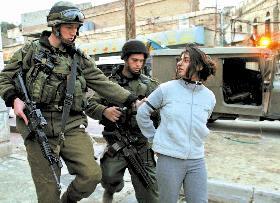
Lines of occupation in the West Bank and Gaza can change overnight. Borders are flexible for the daily incursions of Israeli forces who inflict torture without sullying their home soil. Palestinian homes are a potential theater of war. Palestinian houses are demolished, their farms destroyed and confiscated.
Weizman depicts the Israeli settlements inside the West Bank as built according to a military design of concentric circles, fences, searchlights and patrol roads. In his lecture at the Canadian Center for Architecture in 2007, he refers to them as “optical matrices radiating out from a proliferation of look-out points/settlements scattered across the landscape”. The psychological effects are calculated; fear is used to induce flight and displace the indigenous Palestinian population from their land; a tactic carried out since the 1948 Nakba, Arabic for ‘catastrophe’.
Jon Elmer is a Canadian journalist who has covered recent events in Palestine.
Jon Elmer: It’s important to understand the patterns of the Israel-Palestine conflict have been repeated throughout the last 200 years in any nationalist conflict where indigenous populations were separated from settler populations. In North America, we called them reserves or reservations, the Afrikaners in South Africa called them Bantustans, and in Nazi-occupied Europe they were called ghettos. Sharon, Olmert and the Likudniks prefer to call them ‘cantons’.
What’s interesting about the situation in Israel and Palestine is that the ghettoization of the Palestinians has become legitimized. It’s actually become a national tract, in other words the Palestinian state will actually be the ghettos. In the Gaza Strip there is an open-air prison that has been put under media scrutiny for the last year and a half, but which has existed for the last 20 years.
Immediately following the first Palestinian intifada or uprising in 1987, the creation of the open-air ghetto in Gaza has been on the agenda. It started with checkpoints outside the Gaza strip, proceeding over the years with the creation of a separation wall such as the one in the West Bank. The wall was created ostensibly for the protection of the Israeli settler population that was living an opulent life within the Gaza strip until 2005 when there was the “disengagement” from the Gaza strip.
For someone sitting in the Gaza Strip, if you look up at any moment you can see a radio controlled drone flying over taking pictures, Apache helicopters are not uncommon, neither are F-16 fighters. If one looks out over the sea, which you can at any point in the Gaza Strip, you would see sophisticated 21st century Israeli naval vessels, fully loaded and patrolling the coast and often firing into the coast. You have a situation where people who are university-aged have never left the Gaza strip to see their family, never left to pray at the al-Aqsa mosque in Jerusalem. This is a ghetto population, an imprisoned population.
It’s not a cliché to say it’s an open-air prison. People are not traveling into and out of the territory. The siege that the United Nations has described as ’shocking and shameful’ has led to a caloric intake drop of 50 percent for Palestinians. There’s no energy, no water, and the lack of power and lack of oil and gas make it so that the secondary and tertiary things that require energy are not running. Sewage is not running, water doesn’t run. Choices are being made in hospitals to decide who will get the gauze and who will not.
The siege is total. There are no commercial gas stations open. There’s no cars on the road. There are people pooling their gas and giving it to the Red Cross. You have people literally taking flour off their shelves and taking it down to the baker to bake bread.
The control is total around the border. In fact, as described by Jennifer Lowenstein, an astute observer in the United States who has visited Gaza regularly, in many ways it is worse than an open-air prison in Gaza. In a prison, the walls and gates are closed and the sniper towers are facing out. If someone was to escape from the prison, the sniper towers would be used to cut someone down as they left the prison. In the Gaza strip the towers, the artillery, the aircraft and naval vessels are all facing in to the prison and the attacks come into the prison.
There’s entire buffer zones around the walls in Gaza. People don’t even come close to the wall. This concept of going up to the wall to spray-paint ‘Free Palestine’ is an absurdity, you’ll be shot dead whether you’re a twelve-year old school girl as we saw in Raffah a number of times during the Intifada, or whether you’re attempting to go and pick strawberries, as we’ve seen families being wiped out when they go out to pick strawberries in the field.
What’s most shocking is the normalization of this ghetto prison lifestyle. It’s important to note for the future of the conflict that the Gaza Strip is actually a model for the West Bank. As a reporter who has worked both in Gaza and the West Bank I can tell you that in comparison to Gaza, the West Bank is opulent. Gaza’s population is overwhelmingly refugees packed into refugee camps. It gives squalor a new name.
If you ask a Palestinian what they want the world to know about their living conditions, people will say ‘just come and live here for one day’. If you stand in the Gaza strip and look around, everything is perfectly clear. It’s only when the conflict is obfuscated and confused here in North America that we have such lack of movement and such a normalization of the way the Palestinians live.
David Parker: Let’s speak about the West Bank. According to the philosopher Michel Foucault’s concept of the Panopticon, the architecture of the modern prison constructs an all-seeing eye of the watch-guard, the controlling force that sees into every corner, eliminating privacy and human dignity. Eyal Weizman has applied this concept to the settlements in the West Bank. They exist on top of hills as secure fortresses, the windows of the settler homes look outward and downward into the valleys below where the Palestinian villages are located, separated from the settlements by a wide depth barrier. The settlements are designed to control the valleys and and the psychology of the Palestinians.
What is it like living near Israeli settlements in the West Bank?
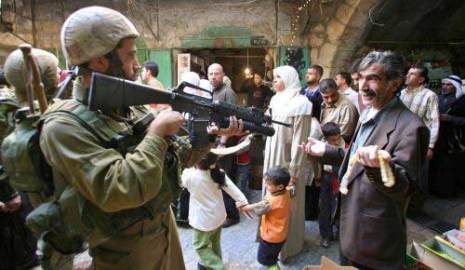
Jon Elmer: The settlements are just one part of the Panopticon equation. You also have over 500 military checkpoints and obstacles, constant military presence, daily incursions into the villages. On an average day there will be 5 to 10 military incursions into West Bank villages. The settler apparatus continues to expand: there are now 235 settlements, 125 of them official. Half a million Israelis are living in the West Bank with super nationality, super rights. They access their own highways, their own roads, their own military protection, water systems, and control the highest of the hillsides, effectively controlling the valleys.
The settlers are not simply families who moved out to pursue a biblical calling. By and large they are economic settlers. There’s no doubt that the settlements are geopolitical, placed on key highways and key aquifers. This is the way the state of Israel has been built since day one.
In 2003, when I was in the West Bank as a journalist, it made sense to travel on settler only roads. Because it might take 2 days to travel 75 kilometers from Jenin in the north to Jerusalem, but by hopping on a settler road you get there in an hour. These are the realities of daily life in the West Bank.
Speaking with some of these settlers on occasion while hitchhiking and asking questions about their lifestyle, I found many were in opposition to the apartheid wall [the 750 kilometer separation wall that weaves in and out of Palestinian territory and expands the state of Israel] because they see it as cutting into their proverbial living room. Palestinians are seen as a temporary nuisance and they can be pushed off into their own state, into Jordan or elsewhere. This has been the settlement project since the beginning of Israel. Like lego bricks, Israel is building settlements and connecting them as part of a long term project.
Some settlers believe the bible has pushed them back to their land. There is a pioneering spirit myth among settlers. But actually the settlements are massive state infrastructure projects. They’re bulldozed and built in a massive, one-fell-swoop style. They’re not building trailer park hill tops, they’re building major cities, which sometimes takes a few years to connect to settlement blocks that are ultimately connected through security roads and buffer zones.
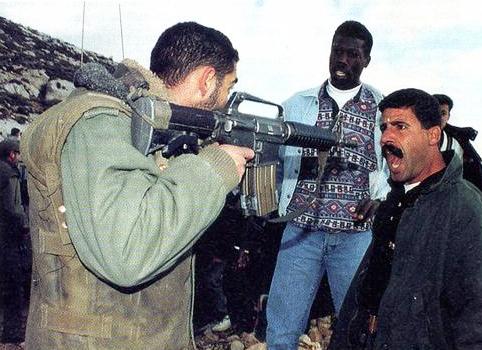
The fence, which you see in Gaza and the West Bank, doesn’t demarcate a border, it demarcates a buffer zone. Palestinians are in danger if they come anywhere near the buffer zone. This control is enforced through a paramilitary regime. The dispossession is carried out through army and military means. What’s going on is a massive project, a collaboration between the state and the settler movement to continually expand the state of Israel while the world negotiates some sort of peace process.
It’s important to understand the role the settlers play. These are not back-to-the-land, pioneering people. They are there to colonize the land, and wherever possible to displace the Palestinians.
--Jon Elmer is a Canadian freelance writer and photojournalist specializing in the Middle East. He has researched and reported from the West Bank and Gaza Strip in 2003, 2005 and 2007.
--David Parker is the news coordinator at CKDU campus-community radio in Halifax, Nova Scotia. This interview is also available as part of an audio documentary available on-line.
_________________________________________________